Personal blog
Articles, reviews and personal notes about movies, books, games, programming and digital creativity.
Posts full articles
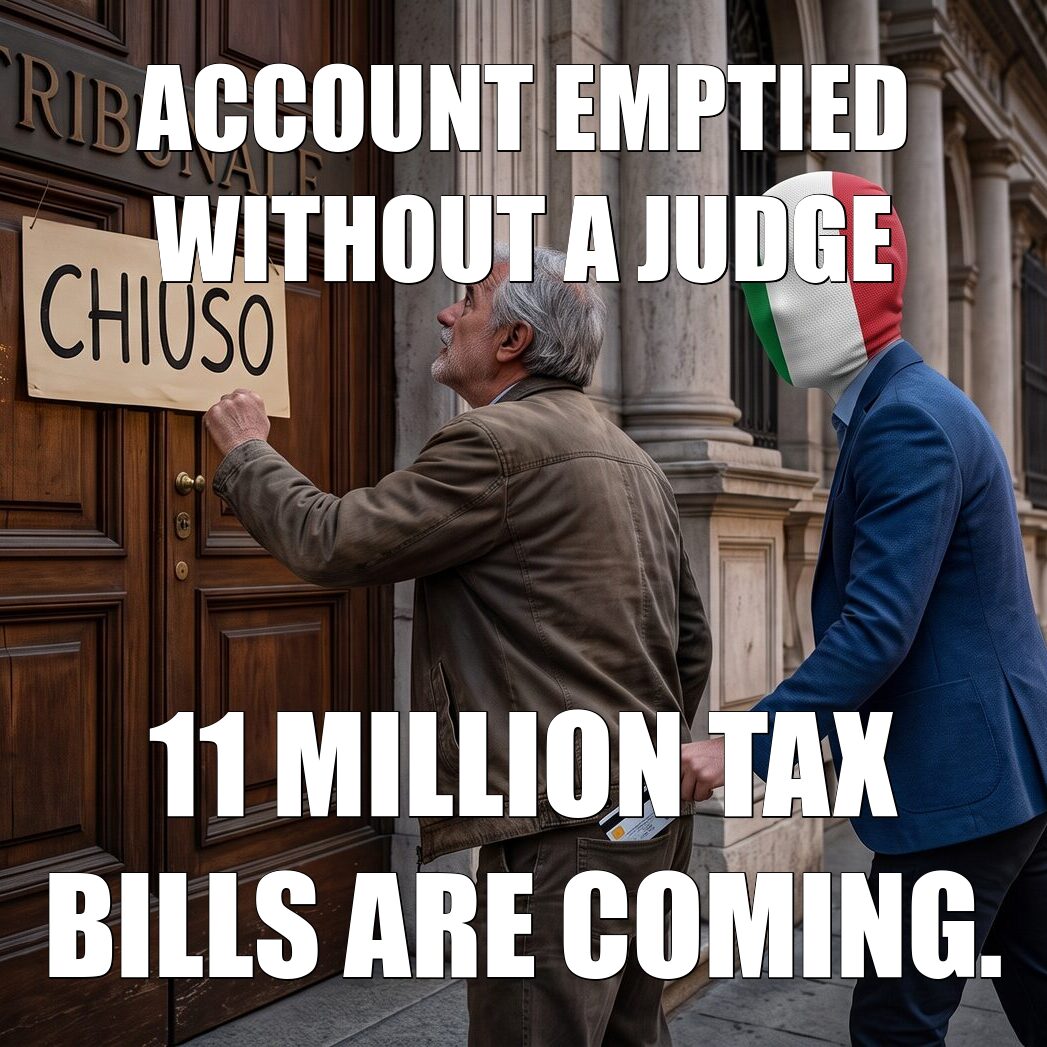
Account emptied without a judge
11 million tax bills are coming.
In July 2026 Italy's tax collection agency announced around 11 million payment notices, and behind that number lies Article 72-bis of Presidential Decree 602/1973, a 1999 rule that lets the tax authorities order a bank directly to pay, with no hearing and no judge. What is new is not the rule but the volume. The account is reached at the end of a chain of acts, from the payment notice through the sixty days to the order to the bank, and seizures have precise limits linked to the social allowance: on the account the last salary payment is protected, on wages the brackets of Article 72-ter apply, and pensions are untouchable below 1,092.48 euros. Besides the account there are vehicle seizures, mortgages, foreclosure and the blocking of public payments, and upstream sits the register of financial relationships, where the GDPR battle is fought.
You defend yourself by checking the notification, which is valid even if the envelope was never opened, the limitation period, the legal challenges and above all instalment plans; a foreign account escapes the order, but moving money to evade it is a crime. Hence the point of view: eleven million notices are about cash, not tax justice, and they hit people with two thousand euros in the bank, not large fortunes, in a state that hands out blanket discounts when it needs consensus and forced collection when it needs liquidity. The surprise is that people keep finding out from their bank statement rather than from the Official Gazette.
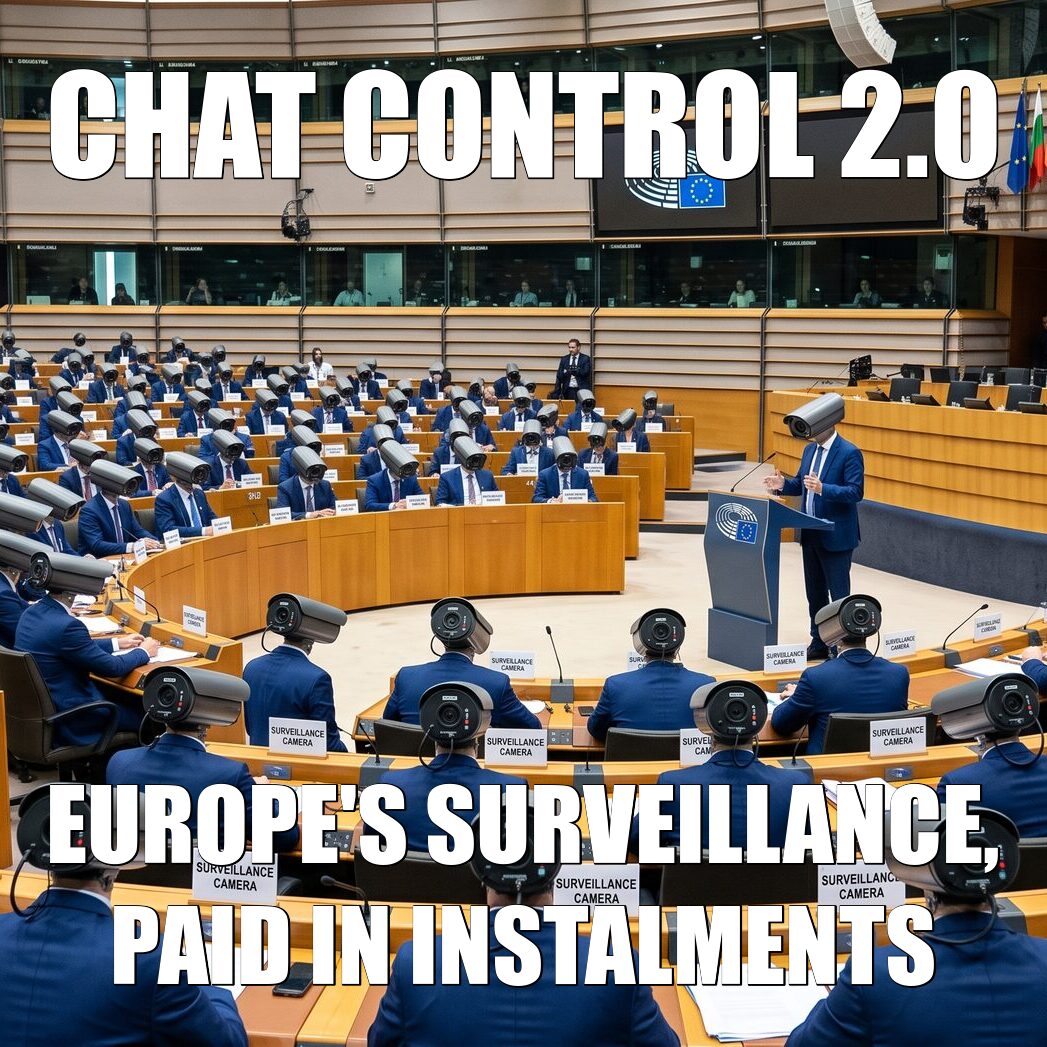
Chat control 2.0
Europe's surveillance, paid in instalments
On 9 July 2026 the European Parliament brought back into force until 2028 the derogation that lets platforms voluntarily scan messages and emails, even though most members present had voted against it: at second reading an absolute majority was required. End-to-end encrypted communications were excluded by a handful of votes, but the principle remains the analysis of everyone's communications, without suspicion and delegated to private companies. This is only the first of three tracks: the permanent chat control regulation, stuck at the fifth trilogue on the choice between generalised scanning and detection ordered by a judge, and the new retention of the metadata of every digital service, encrypted messengers included. In Italy, the decree implementing the AI Act allows facial recognition authorised by the public prosecutor rather than by an independent judge.
Together, the three tracks normalise generalised suspicion along the lines of the Overton window: the maximalist proposal shifts the centre and whatever is left looks like a reasonable compromise. The objections of the European Data Protection Supervisor and the German authorities, from false positives to weakened encryption, remain unanswered. Mass surveillance never arrives with a single vote: it comes in instalments, and each instalment looks small.
Four Laws That Will Tell Us Who We Are
Elections, autonomy, security and welfare
July 2026 put four dossiers on the lawmakers' desk which, read together, tell where the country is heading. INPS presents itself as a "welfare workshop", but behind the slogan pensions rely more and more on general taxation, with a gap of about 77 billion a year between benefits and contributions. Differentiated autonomy is back on track, with the Senate approving the preliminary agreements despite the Constitutional Court's cuts and the referendum declared inadmissible, while the accounts and the issue of the essential service levels remain open.
The "Stabilicum", passed at first reading by the Chamber, brings closed lists without preference votes and a fixed majority bonus at 42%, with constitutional doubts already on record. The "save-Roggero" rule in the Security bill, which denies compensation to anyone injured while committing serious crimes, would not even save Roggero and raises an equality issue. All but autonomy are still proposals, and they should be followed by telling the announcement from the law and the law from its real effects.

The Jeweler Case: Defense or Punishment?
In New York or Canada the outcome barely changes.
In 2021 the jeweller in Grinzane Cavour shot three fleeing robbers in the back, killing one, and kicked one of the wounded on the ground: convicted of murder, he was sentenced to fourteen years on appeal. A comparison with other legal systems shows that self-defence almost everywhere requires an imminent threat: only Texas would have given him some arguments, while New York, with its duty to retreat, and Canada would almost certainly have convicted him. This dispels the cliché that "abroad he would have got away with it", because what sinks the defence everywhere is the shots in the back and the kicks to a robber who was already harmless.

Nuclear in Italy 2026: who pays?
Just an excuse to stop the referendum?
The Government is discussing very expensive compact nuclear power plants, but given Italy's financial constraints it remains unclear who will pay for them. An enabling law cannot print the funds that are missing, which raises the suspicion that its real purpose is simply to block the referendum.

Shorts archive

PlayStation Will Stop Producing Physical Games by 2028
This all-digital shift can be bypassed using alternative storefronts and game keys


Other tags
Tags with older posts or without published articles yet.
Support us with Buy Me a Coffee.
Buy Me a Coffee