
A difficult watch, because it demands a lot of interpretation
Angel's Egg (Tenshi no Tamago), released in Italy as L'uovo dell'angelo, is the animated film directed by Mamoru Oshii in 1985, with character design and illustrations by Yoshitaka Amano. It follows a girl who watches over a large egg in a dark city and her encounter with a man armed with a cross. In Italy it reached cinemas for the first time in December 2025, in the 4K restoration distributed by Lucky Red.
That egg and that city come from far away: the story is a very personal reworking of Noah's ark, the tale of the flood told in Genesis (chapters 6-9), moved into a post-apocalyptic setting. In this world everything has died: the animals were not saved, or rather, they were saved on the ark but they have turned into fossils, into stone.
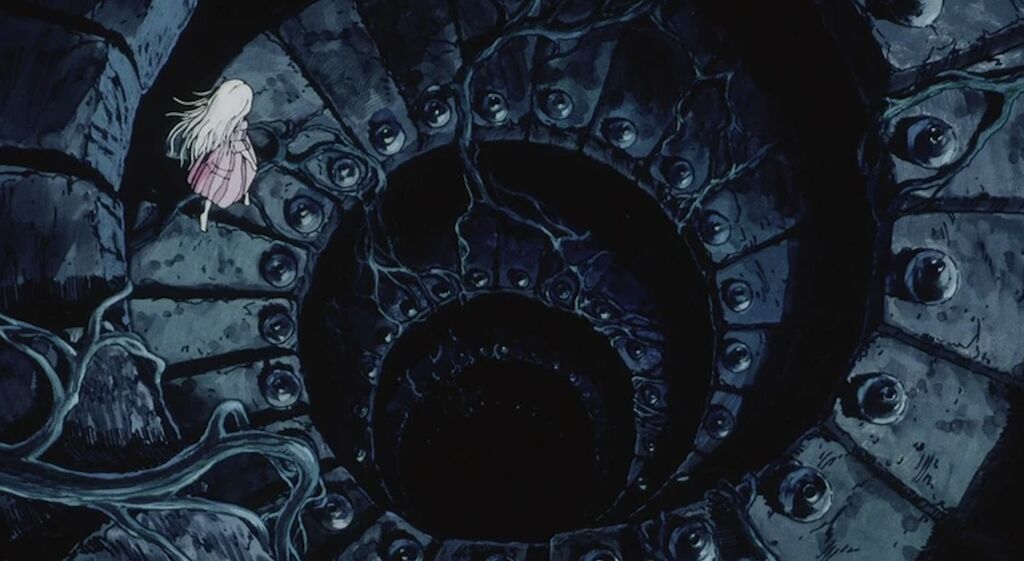
The inhabitants too, fishermen for the most part, are alive in body but dead in soul. In this dark world they try to fish in vain, because all there is are shadows of fish. It is a nod to the miraculous catch of fish in the Gospels, where the nets come back full: here the film does exactly the opposite, in keeping with the disaster that has taken place. A disaster that, the author suggests, was not caused by God, but by the weapons — brought to life — that man produced himself. And it is at this point that the man with the cross comes in.
The film is a very interesting work and leaves plenty of room for visual interpretation. It does not use explicit dialogue, but an intense play of glances, where language is not only speech: the film, in fact, has no need for dubbing. While the girl with the egg stands for the last hope of life, the man stands for cynicism and wants to snuff out every life in this world, trying to win the girl's trust as well.

Another very peculiar scene, and one that comes back more than once, is the gathering of the water flasks and the way she arranges them in the storeroom of fossils: honestly, I did not really understand the meaning of that action, as if it were a rite, a routine. A gesture that, in a world full of water, makes no sense, but that she considers necessary.
The work is not very musical, but its rhythms are memorable: to give meaning to the images it uses almost only sound and ambient noise. Another feature of the film is its extreme use of an experimental cinematic and directing style, innovative for its time.
It was really hard to build a logical sense out of the film, at times too cryptic, at times a little heavy. It is a film meant for those who love art cinema and appreciate this kind of arthouse film.